
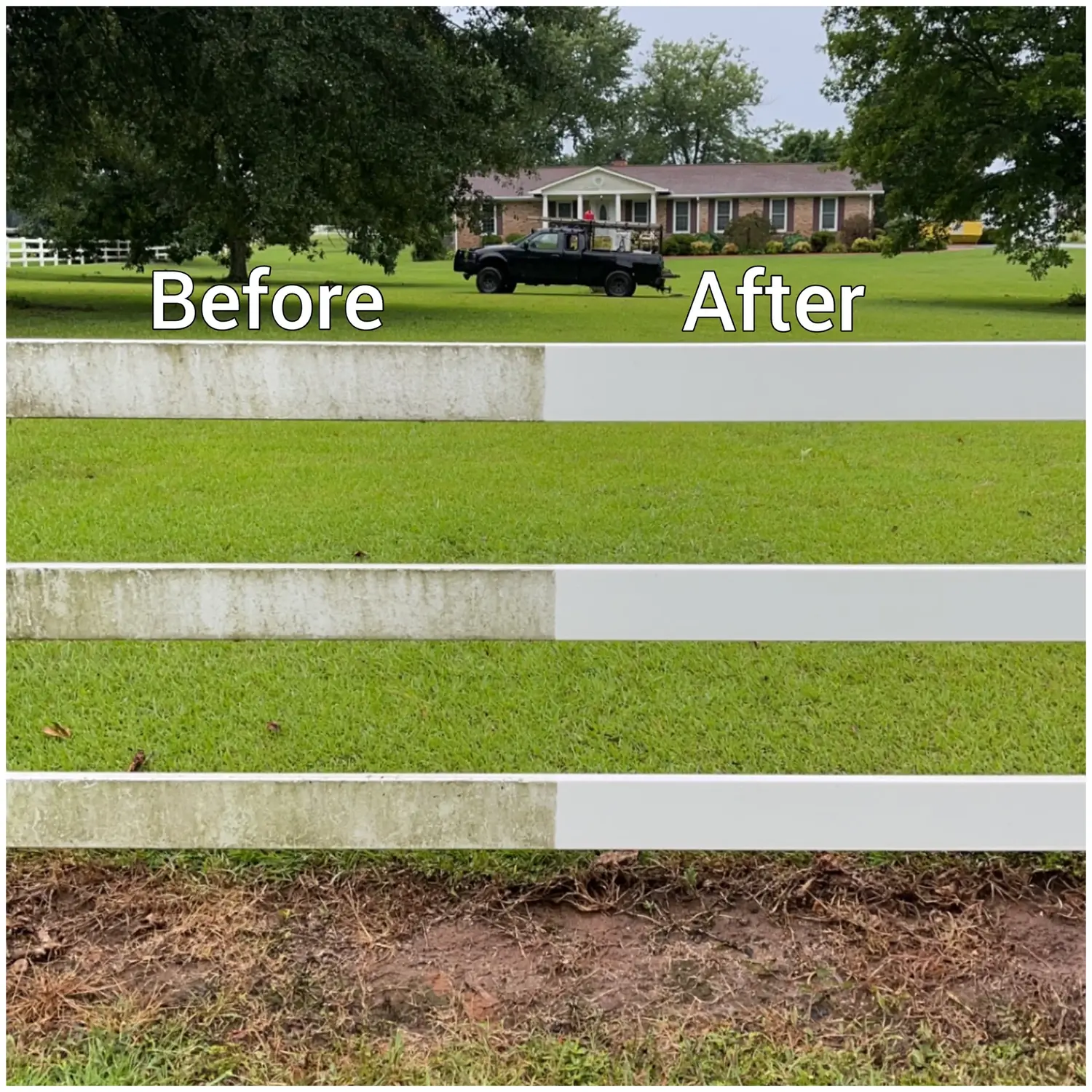
Why fences turn green here
Vinyl does not rot, but it is not maintenance-free. The shaded faces of a fence — usually the north and east sides — stay damp long enough after every rain for airborne algae to take hold. Add North Alabama humidity, sprinkler overspray, and a fence line under trees, and you get the familiar green film that creeps up from the bottom rail first.
The green is a living colony, not dirt. That distinction matters because it decides the right fix: rinsing a living colony just moves it around and it returns within weeks. The treatment has to kill the growth, and the dead residue then rinses away at low pressure.
Why we do not pressure wash vinyl fences
A pressure washer will make a fence look clean from ten feet away. Up close it leaves problems: etched panels that hold dirt faster than before, visible wand marks in straight lines, and water driven through the tongue-and-groove seams into the hollow posts where it sits and feeds the next round of growth.
- Etching. Vinyl is softer than it looks. A wand tip at close range permanently roughens the surface, and the rough surface re-stains faster than the original finish ever did.
- Wand marks. Striping on a fence is nearly impossible to blend out because every pass shows against the panel seams.
- Water intrusion. High pressure forces water through the joints into posts and rails, where it cannot dry quickly.
- Kicked-out panels. Vinyl panels flex. A direct blast at the wrong angle can pop a panel out of its rail entirely.
Our fence cleaning process
Walk the fence line
We note the material, the worst growth areas, loose panels or caps, and everything growing or planted along both sides.
Pre-wet the landscaping
Grass and plants along the fence get soaked first so nothing absorbs treatment. This is the same plant-protection step we use on every soft wash.
Apply the soft wash treatment
A hypochlorite and surfactant blend goes on at low pressure, bottom to top so it does not streak. It clings, dwells, and kills the algae at the root.
Low-pressure rinse
Once the growth is dead, the residue rinses off at roughly garden-hose pressure. Dead algae lets go easily — there is no reason to blast it.
Rinse plants, walk it with you
Vegetation gets a final rinse so nothing dries on it, then we walk the fence with you or send photos of every face.
Wood and metal fences
The same soft wash approach adapts to other fence materials. Wood fences get lower pressure and a milder mix so the grain does not fur. Aluminum and painted metal handle the standard treatment well. If your fence is a mix — vinyl panels on wood posts, for example — we treat each material the way it needs to be treated, not the fastest way.
Pair it with the rest of the exterior
A fence job is usually part of a bigger cleanup. The same algae that greens your fence is on your siding, so most homeowners pair the fence with a house washing on the same visit. If the fence borders a driveway or patio, adding concrete pressure washing while we are already set up is the cheapest way to do both. Bundling services on one visit always prices better than separate trips.